
While Europe languished in the Dark Ages, Persian astronomers measured star positions with unprecedented accuracy, built massive observatories, and created star catalogs that guided sailors for centuries. These scholars corrected ancient Greek errors and revolutionized our understanding of the cosmos.
1. Al-Khwarizmi Created Astronomical Tables That Outlived Empires

Ancient star charts that shaped medieval science
Muhammad ibn Musa al-Khwarizmi compiled the Zij al-Sindhind around 820 CE, a set of astronomical tables that calculated planetary positions with remarkable precision. Working in Baghdad’s House of Wisdom, he adapted Indian and Greek methods to create 37 chapters covering everything from solar eclipses to the movements of the moon. His tables remained the standard reference across the Islamic world for over 200 years, used by navigators from Spain to India. The word “algorithm” derives directly from the Latinized version of his name, Algoritmi.
Source: britannica.com
2. Abd al-Rahman al-Sufi Discovered Galaxies Nobody Would See Again for 700 Years
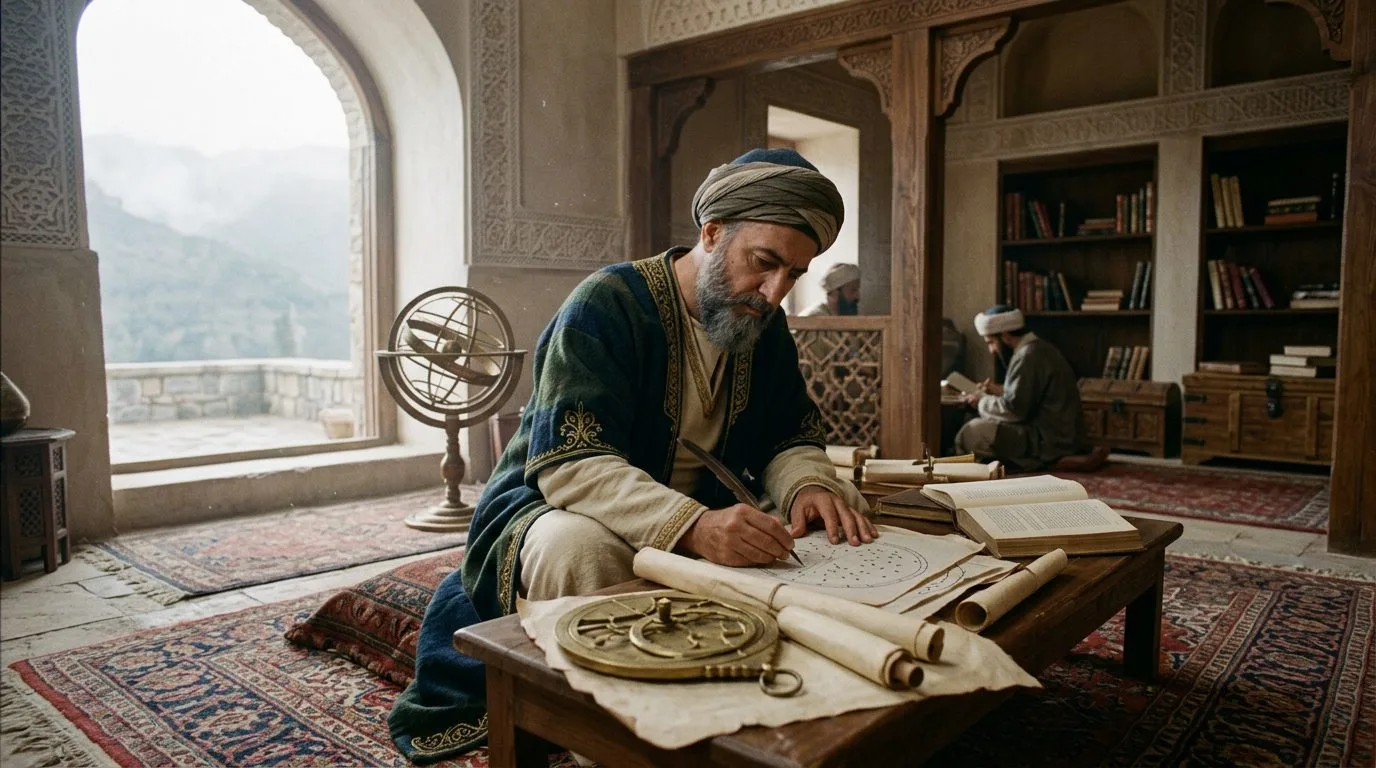
Medieval astronomer’s telescopic records.
In 964 CE, al-Sufi published the Book of Fixed Stars, describing 1,018 stars with unprecedented detail including their brightness, color, and exact positions. He became the first astronomer to record the Andromeda Galaxy, calling it a “small cloud” near the constellation Andromeda. His catalog also identified what we now know as the Large Magellanic Cloud, visible only from Yemen’s southern latitudes where he conducted observations. Al-Sufi’s magnitude system for measuring star brightness remains the foundation of modern stellar classification.
Source: britannica.com
3. Omar Khayyam’s Calendar Was More Accurate Than the One We Use Today
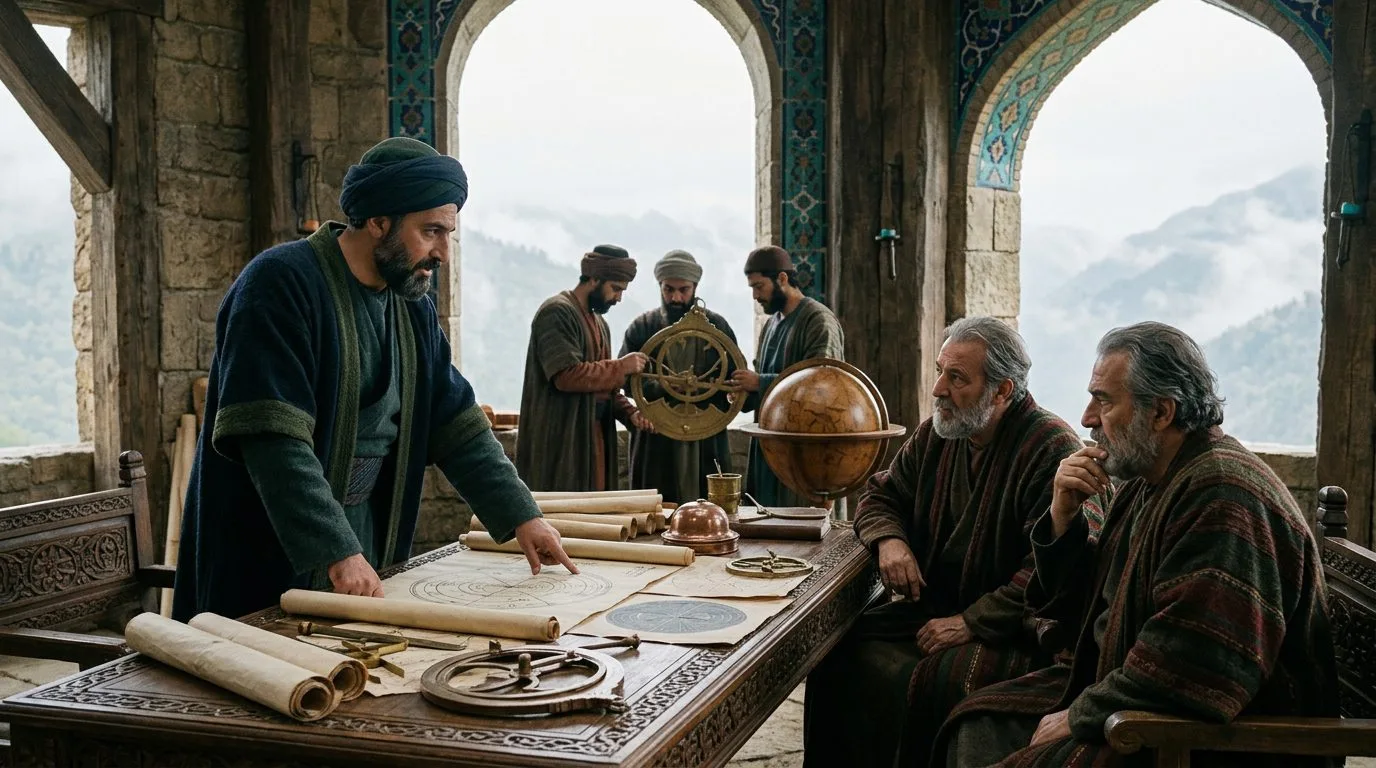
Khayyam’s 11th-century calendar outperformed
Omar Khayyam led a team of eight astronomers in 1079 CE to reform the Persian calendar, creating the Jalali calendar with an error of only one day in 3,330 years. By comparison, the Gregorian calendar we use today drifts by one day every 3,226 years, making Khayyam’s version technically superior. He calculated the length of a solar year as 365.24219858156 days, differing from modern measurements by less than one second. His observatory in Isfahan used a 90-foot meridian arc to track the sun’s position with revolutionary precision.
Source: britannica.com
4. Nasir al-Din al-Tusi Built an Observatory That Challenged Ptolemy’s 1,400-Year Reign

Maragheh Observatory challenged ancient astronomy.
Al-Tusi convinced the Mongol ruler Hulagu Khan to construct the Maragheh Observatory in 1259 CE, the most advanced astronomical facility of its age. The observatory housed a library of 400,000 volumes and employed 100 staff members from across the Islamic world and China. Al-Tusi developed the “Tusi-couple,” a mathematical device that explained planetary motion without Ptolemy’s problematic equant point. His Zij-i Ilkhani tables, compiled over 12 years of observations, corrected errors in Ptolemaic astronomy that had persisted since 150 CE.
Source: britannica.com
5. Ulugh Beg’s Giant Sextant Could Measure Star Positions to Within One Second of Arc
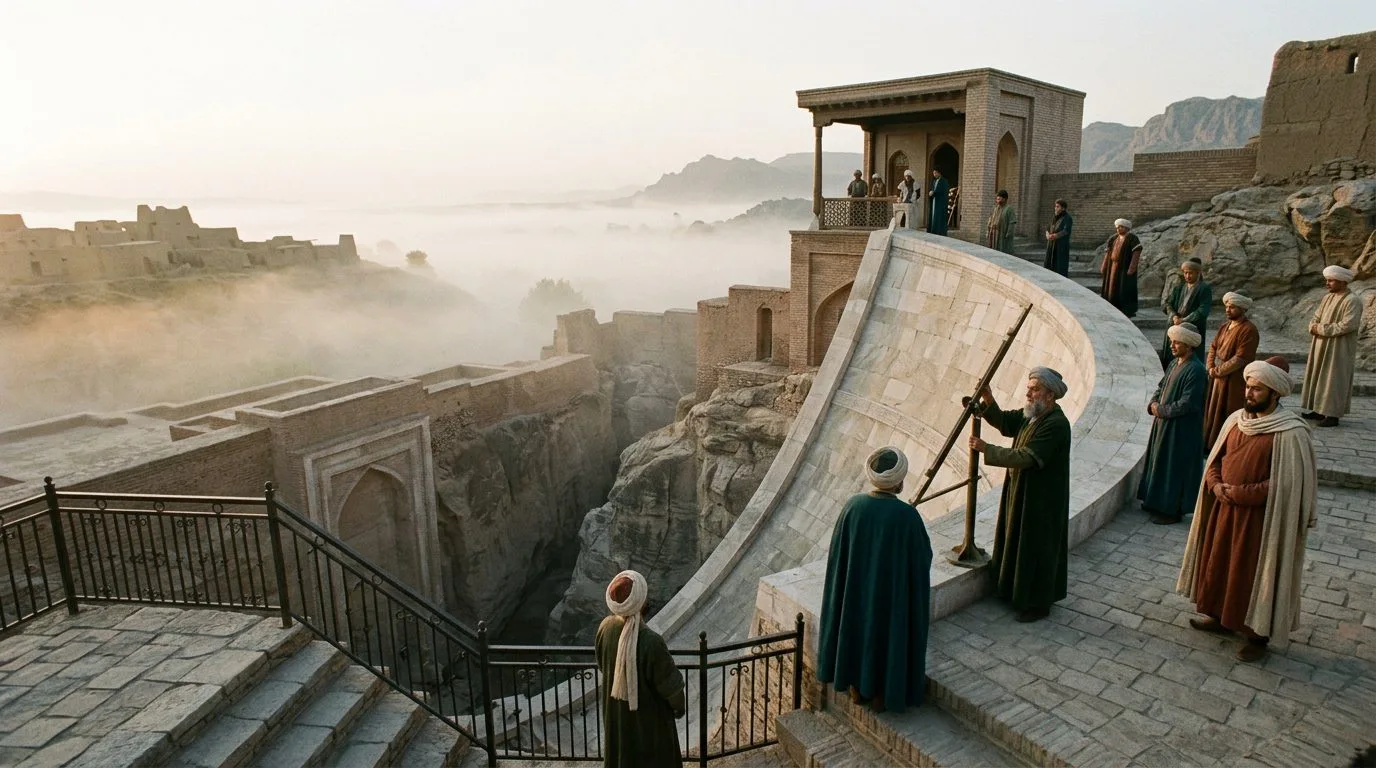
Ulugh Beg’s massive sextant revolutionized
Sultan Ulugh Beg constructed a three-story sextant in Samarkand in 1428 CE with a radius of 131 feet, making it the largest astronomical instrument ever built. Carved into bedrock and faced with polished marble, the device measured stellar positions with accuracy not surpassed until the invention of the telescope. His star catalog of 1,018 celestial objects, completed in 1437, remained the most accurate available to European astronomers until 1627. Tragically, his own son ordered his assassination in 1449, and the observatory was destroyed shortly after.
Source: britannica.com
6. Al-Biruni Calculated Earth’s Radius Using Only a Mountain and Basic Geometry

Ancient scholar Al-Biruni measures Earth’s
Abu Rayhan Al-Biruni measured Earth’s circumference in 1025 CE by standing atop a mountain in Punjab and measuring the angle to the horizon. His calculation of 6,339.6 kilometers for Earth’s radius differs from the modern value by less than 17 kilometers, an error margin of only 0.27 percent. He also determined that light travels faster than sound through experimental observation of thunder and lightning. Al-Biruni wrote 146 books covering astronomy, mathematics, and geography, mastering seven languages to access scientific works from multiple civilizations.
Source: britannica.com
7. Qutb al-Din al-Shirazi Explained Why Rainbows Have Seven Colors Centuries Before Newton

Medieval scientist explains rainbow optics.
In 1304 CE, al-Shirazi provided the first mathematically correct explanation of rainbow formation, describing how sunlight refracts twice inside spherical raindrops. He calculated that primary rainbows result from one internal reflection while secondary rainbows require two reflections, explaining why the color order reverses. Working independently, his student Kamal al-Din al-Farisi experimentally verified the theory using a glass sphere filled with water. Al-Shirazi’s work preceded Isaac Newton’s investigations of light refraction by more than 350 years.
Source: britannica.com
8. Al-Battani’s Observations Corrected 23 of Ptolemy’s Most Critical Errors
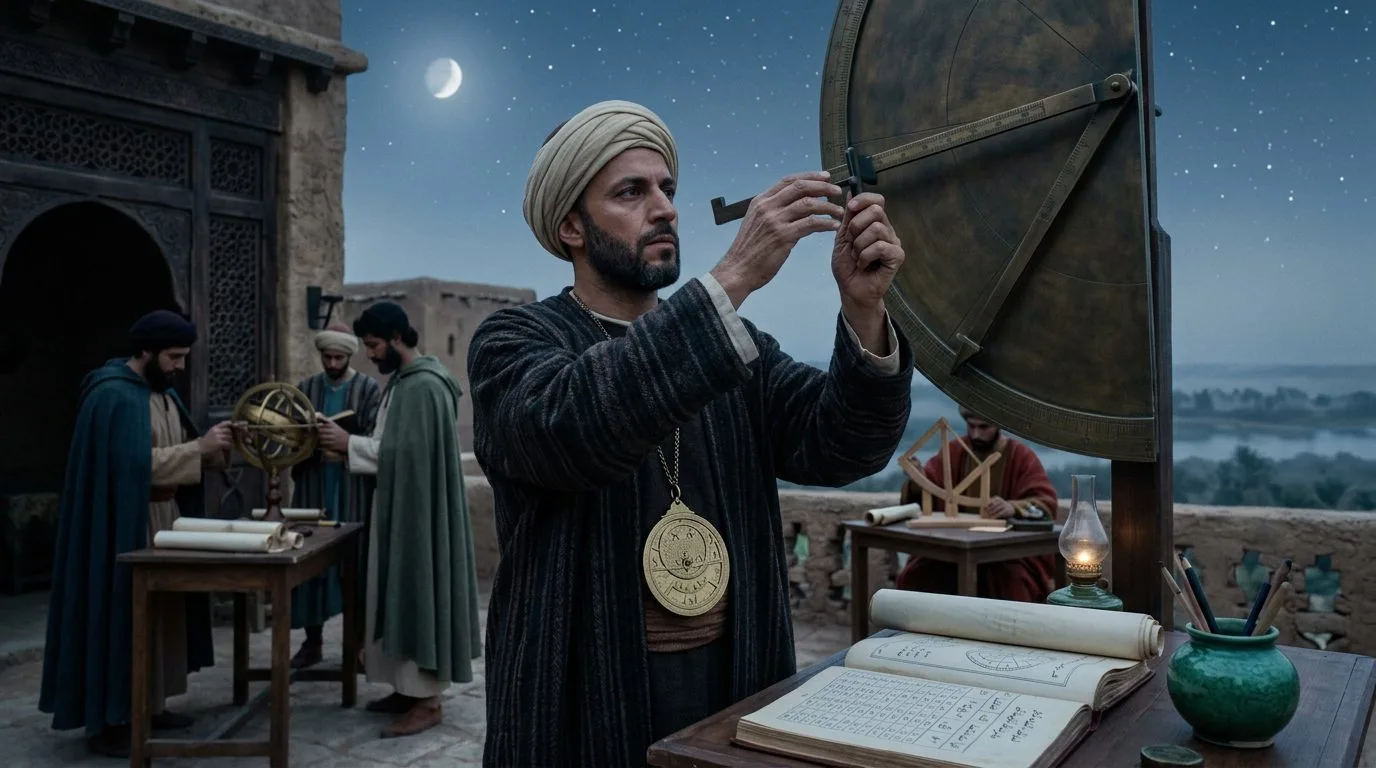
Al-Battani’s astronomical corrections
Muhammad Al-Battani conducted systematic observations from 877 to 918 CE in Raqqa, Syria, producing astronomical tables that remained Europe’s primary reference for six centuries. He determined the solar year’s length as 365 days, 5 hours, 46 minutes, and 24 seconds, missing modern calculations by only 2 minutes. Al-Battani proved that the distance between Earth and the Sun varies throughout the year, contradicting Ptolemy’s assertion of a constant distance. His De Motu Stellarum influenced Copernicus, who cited al-Battani’s observations in his heliocentric theory.
Source: britannica.com
9. Jamshid al-Kashi Calculated Pi to 16 Decimal Places Using Only Pen and Paper

Al-Kashi’s remarkable mathematical achievement.
Working at Ulugh Beg’s Samarkand Observatory in 1424 CE, al-Kashi calculated pi to 16 decimal places, a record that stood for 180 years. He achieved this feat by computing the perimeter of a polygon with 805,306,368 sides, performing calculations entirely by hand. His treatise Risala al-muhitiyya (The Treatise on the Circumference) also introduced decimal fractions to the Islamic world. Al-Kashi developed an astronomical computing device with 8 plates capable of modeling planetary positions, essentially creating a mechanical analog computer.
Source: britannica.com
10. Taqi al-Din Built Three Observatories in One Year Before Politics Destroyed Them All
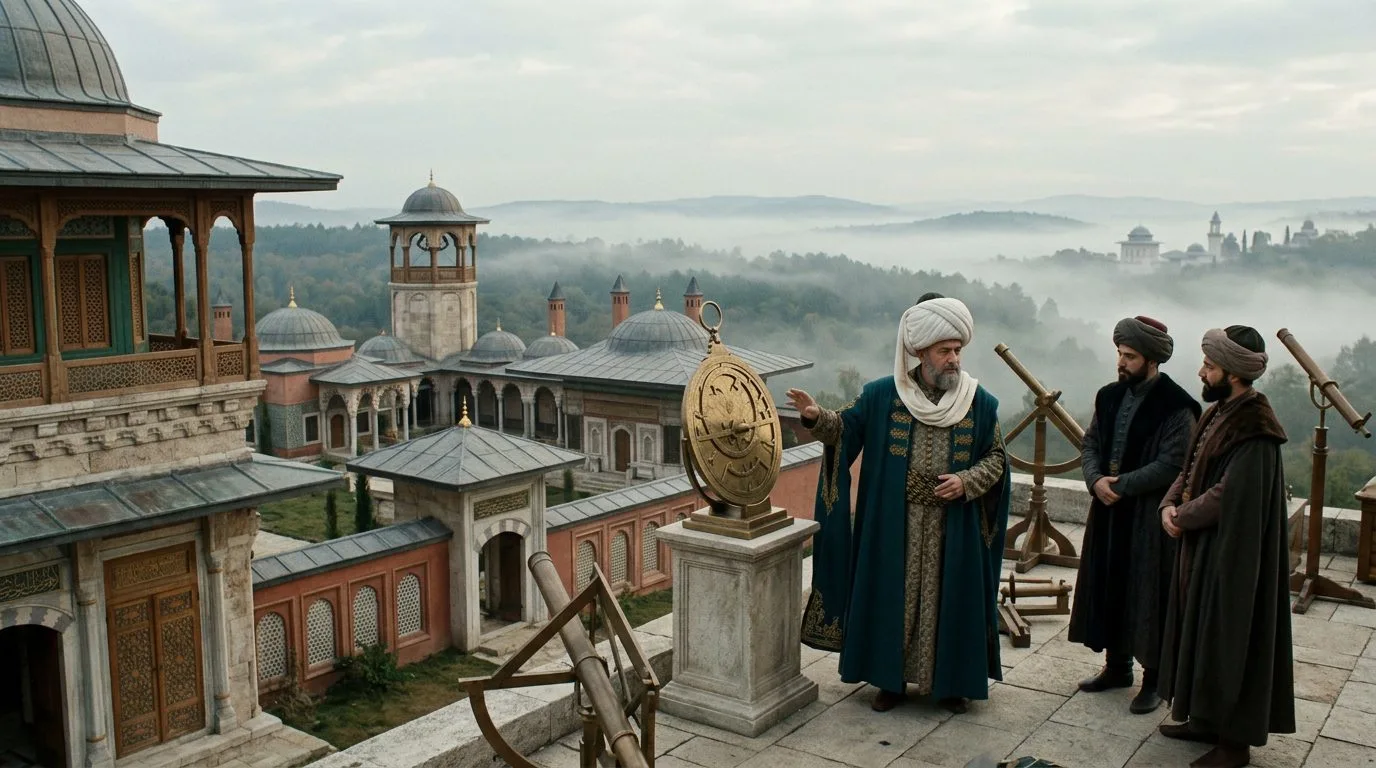
Taqi al-Din’s observatories lost to political
Ottoman astronomer Taqi al-Din convinced Sultan Murad III to construct the Istanbul Observatory in 1577 CE, completing three separate buildings in just one year. His observatory featured innovative instruments including an astronomical clock accurate to one minute per day and a massive mural sextant for measuring star positions. Taqi al-Din produced a star catalog of 1,018 stars and observed the Great Comet of 1577 with unprecedented detail. However, when he predicted Ottoman military victory based on astronomical calculations and the campaign failed, religious authorities convinced the Sultan to demolish the observatory in 1580.
Source: britannica.com
Did You Know?
Did You Know? The astronomical tables created by these Persian scholars were so accurate that Christopher Columbus used them to navigate to the Americas in 1492, and European sailors continued consulting them well into the 1600s. Ironically, many of these astronomers faced persecution or execution for their scientific work, yet their calculations proved more durable than the empires that destroyed their observatories. The next time you check the time or use GPS navigation, you’re relying on mathematical principles these medieval Persian scientists established over a thousand years ago.